
-
Follow Us
-
Search
-
Recent Posts
- sole society alessandra bag
- pevonia botanica ligne soleil
- rock the crop
- style for your iPhone
- Swimsuit trends: Itsy Bitsy
-
Recent Comments
- Quantumnerd on Ralph Lauren hires first plus-size model
- The ranch is a runway: Why Texas is a luxury brand hotbed | KayandJerry-Watkins.org on Y’all ready for this? Karl Lagerfeld is coming to Dallas
- on The most important paper you’ll ever write. Or is it?
- on TOMS Aviators change your look — and more
- on alex and ani: my new sweethearts
-
Archives
-
Categories
Category Archives: Articles
a fashion life re-invented
 by Ruthie Burst
When Samantha Mastropolo started selling cosmetics in her hometown of London, she didn’t know she’d soon be working in another part of the fashion industry: modeling.
One day a hairdresser friend asked her to be a hair model in a photo shoot. After the shoot, the photographer showed the photos around. The lithe, blue-eyed Mastropolo caught the attention of an agency, and she was quickly signed. Thus, her career launched in the early ‘90s, when she was 24 years old – a bit late by modeling standards. And perhaps an early clue that she would re-invent herself more than once over the course of her journey.
Modeling
Mastropolo’s career took off relatively fast – but not in London. Her agency relocated her to different markets. She had the most success in Europe and Asia, and worked in Korea, Tokyo, London, Germany and Spain. She says she traveled constantly, calling that one of the “pros” of a model’s life.
Mastropolo says she mostly did print work and was featured in an ad for Versace Makeup as well as two campaigns for Max Factor. Mastropolo also walked the runway for top designers such as Versace, Armani, Issey Miyake, Gucci, and more.
“Print was my strongest point,” says Mastropolo. “Runway wasn’t my favorite because that’s where I lacked the confidence.”
Mastropolo says she used to get butterflies before stepping on the catwalk. She thinks confidence is a characteristic that allows models to shine and differentiate themselves from others but says it’s a quality that develops over time.
As a working model, she says, it was also critical to maintain certain body measurements. During the time Mastropolo modeled, the Kate Moss heroin chic look was in high demand.
Mastropolo says overall her modeling experiences were wonderful, but the downside was feeling like she had to look good at all times.
“I remember I was doing a shoot for Marie Claire and I had a massive spot on my chin and there was nothing I could do about it,” says Mastropolo. “It’s that constant struggle to maintain your weight or to have healthy looking skin and make sure you don’t have bags under your eyes.”
Hair & Makeup Styling

After approximately six years of modeling, Mastropolo lost interest. She realized she didn’t want to model and travel anymore.
“I was kind of over it. I was like, I’m done,” says Mastropolo. “There’s a season for everything and that season for modeling was over and I knew it so it was time to start something new.”
She says it’s a good idea for models to have alternative plans for the future because typically modeling careers don’t continue past the age of 35.
“Modeling is a great job to have when you’re young but not one to rely on for life,” says Tori Taylor who used to model for the Kim Dawson Agency.
At 28, Mastropolo moved to the United States and decided to become a hair and makeup stylist for both photo shoots and runway shows. She attended Jenni Tarver Academy to master her skills.
She picked up the techniques of makeup fairly quickly but struggled with hair styling. But since she wanted to start her career in Dallas, she knew she had to learn both. The New York fashion industry separates makeup stylists from hair stylists, but in Dallas stylists are expected to do it all.
When Mastropolo attended hair and makeup castings, she would tell photographers about her experience as a model. As a result, the teams casting the jobs trusted her styling talents more because of her background, she says.
Mastropolo has done hair and makeup styling for Neiman Marcus, Dillard’s, JCPenny, People Magazine, Glamour, GQ, Don Henley, Mark Cuban, Tiger Woods, Nike, and more. This work consisted of campaigns, magazine spreads, and advertisements.

Mark Cuban featured in GQ magazine. Photography by Terry Richardson, hair & makeup by Mastropolo.
Mastropolo also applied her hair and makeup skills to ministry work for Queen Esther’s Court, mother and daughter inner-beauty conferences. She focused on teaching girls how to apply makeup modestly to showcase their “inner beauty.”
“Sam has a heart for missions, helping reach those less fortunate in practical and spiritual ways,” says model April Barr, who met Mastropolo on the set of a photo shoot. “The women enjoyed learning practical tips from Sam, yet most importantly they learned that developing true character was what makes a person’s beauty shine brighter.”
Photography
Mastropolo worked in hair and makeup for about four years and then decided to change paths again, this time venturing into fashion photography. “It [moving into photography] was a natural progression,” she says.
She went out and purchased a camera and learned to use it before completely jumping into her new career. Mastropolo says the key to photography is light and emotion and capturing the two at the same time. She learned this during her modeling career, which helped her pick up the skills of her new profession.

A Mastropolo photo.
“Working with photographers is my favorite part about modeling,” says Kim Dawson model Lindsey Anderson. “It makes it even more fun when they have been on the other side of the camera because they are able to relate to you and capture really great images.”
Mastropolo was able to relate to the models and bring out their personalities on set. Thanks to her previous experience working in Dallas’ fashion industry, she had established strong relationships with top agencies, models, and hair and makeup stylists. These connections also helped Mastropolo when she found herself on the other side of the camera.
While many aspects of her photography career evolved rapidly, there were challenges. Mastropolo says the transition proved to be a struggle at times because fashion photography, especially when one is new to the business, is not necessarily a lucrative career.
For instance, Mastropolo says she worked out of her garage instead of renting a studio. Photography equipment was expensive and she didn’t want to spend more money early in her career.
In addition, as the Dallas fashion scene has grown over the past few years, more photographers are launching their careers here — and are willing to shoot for free, just to get noticed. This creates the expectation that others new to the business will shoot for free as well, Mastropolo says.
The result: This established pro went back to hair and makeup styling, the part of her fashion career that Mastropolo says allowed her to express the most creativity.
The one piece of advice, she says, for anyone interested in a fashion career: Don’t become discouraged if you hear the word “no.” “Expect a lot of no’s,” says Mastropolo. “You will get no’s, but you have to keep knocking on doors, and you have to remain positive.”
The Sweet Smell of Success

Photos courtesy of Morgan.
By Elle Finney
The move from selling fertilizers to creating and marketing a line of fragrances may seem an unlikey career path.
But lucky for Niven Morgan, the years he spent working in a family business, delivering shipments of minerals and fertilizer around the state, provided the very tools he needed to make the change — some knowledge of the alchemy of scents, a saleman’s knack for service . . . and plenty of time to think.
Morgan was sitting in traffic during his routine commute when he had the epiphany that forever changed his professional life: Putting simple, sweet-smelling bath salts inside a decorative vase would give the product a unique touch.
Morgan first pitched his idea to Michaels, the national chain of craft and home decor stores. Although Michaels didn’t sign on, the seed was planted. Morgan began experimenting, combining his favorite scents and tossing around ideas with family and friends, as well as keeping a close eye on trends in the bath, body and home products industry.
Morgan knew he was on track when he developed a scent with notes of vanilla and amber and appropriately christened it “Gold.” Gold was the first signature fragrance of Morgan’s collection — used in products from bath salts to lotions — and to this day it still holds the title as his best-selling scent.
It took Morgan three years to turn his cottage industry into a full-time career — and thriving business. Today, 15 years after Morgan’s initial epiphany, his Dallas-based company sells a variety of luxury candles, soaps, lotions and home scents for both men and women to retailers throughout the country.
Customers swear by his products, which they praise as high-quality but never over-designed. The clear containers that hold Morgan’s bath salts and lotions are simple and sleek – they can fit into any kind of décor.

Photo courtesy of Morgan.
A travel-enthusiast, Morgan says the inspiration for his fragrances come from the places he has visited – everywhere from New Orleans to Mustique. “No matter if it’s a key in a hotel room, or the way a hotel room is designed, or the way they greet you,” the experience as a whole influences his work, he says.
SMU student Shelby Sanderford appreciates Morgan’s location-themed scents. Sanderford first heard about Niven Morgan when she smelled a candle at a friend’s apartment that reminded her of her hometown, New Orleans.
“The ability to turn something so simple into something that re-generates a smell from a far-away place and brings back irreplaceable memories is so unique and my favorite aspect of his products,” Sanderford says.
As a local, Morgan has found support in the Dallas business community. His products have proved to be a natural match for The Impeccable Pig, a Dallas-based boutique, which now stocks them on a regular basis.
Allison Treadway, Impeccable Pig manager, says that Morgan’s products have become go-to gifts. “The Gold scent is appealing to customers of all ages – we see everyone from middle-school to people in their 70s buying the products. Men as well,” Treadway says.
One of the greatest lessons Morgan learned while working for his fertilizer company was the importance of relationships with clients. He often attends events at The Impeccable Pig, and Treadway says she values the level of service he provides.
The interpersonal relationships he develops with his retailers and customers are, Morgan believes, key to his success. He doesn’t just sit behind a desk and tell people what to do.
He gets involved on the front lines to make sure everything is perfect. Like any good salesman.
put a ring on it
by Amelia Ambrose

image via http://img2.timeinc.net/instyle/images/2012/WRN/082112-kim-catrall-sex-and-city-340.jpg
“This flower ring is the essence of me. One of a kind, filled with fire (and a little too much).” – Samantha Jones, Sex and the City
Samantha Jones from Sex and the City is all about “me.” She works hard for her money and believes she can do whatever she wants with the freedom that her career gives her. Samantha is a powerful personality who believes that women should make a name for themselves by acting like men to get what they want in their personal and professional lives.
Although Samantha is a fictional character, she does have a point. Buying items, like fancy rings, for ourselves because we can is in every way worth it. It signifies that we no longer have to rely on men to buy them for us, thank you very much.
Sure, it is nice to receive jewelry from a significant other every once in a while. But today, with the education many of us are receiving from universities and the careers we are pursuing, having the means to treat ourselves is within reach. We do not have to spend $50,000 on a ring like Samantha, but we can purchase accessories that work within our budget.
A ring — or a bag or any other accessory — is an easy way to completely change the look of an outfit. Even something as ridiculous as buying an expensive piece of jewelry is sometimes more affordable than buying a completely new ensemble.
By changing the way we mix and match accessories with different pieces from our wardrobes, we can greatly expand our outfit options without making a huge investment. This is important for us when we head out into the workplace. After all, until we’re named CEO we are going to have to work with what we have to stay fashionable and on budget.
The beauty of being a woman in the 21st century is that we have the ability to splurge on these little “necessities.” We have come a long way throughout history. In the 1950s most women did not have the luxury of buying accessories the way we do now. Most of the jewelry my grandmother owned was passed down from her mother – an heirloom. Only for special occasions would she purchase a simple necklace or ring.
Fashion historian Chelsea Bell agrees that women’s spending habits today reflect a new form of independence. “I think women spending money on themselves is a strong sign of female empowerment. It signals that women are earning disposable income and are in charge of how they spend. “
Having the ability to spend money on accessories does not scream female empowerment to everyone. Professor Beth Newman of the English department believes that female empowerment has changed from women who fight for equal rights to women who fight for their right to spend money in on superficial status symbols.
There are as many differing opinions on the issue of female empowerment — and our right to splurge on ourselves, because “we’re worth it — as there are women.
One thing remains true: As time has passed, women have fought for equal rights and independence. With this independence we have the opportunity to do what we want. We can make as much money as men, buy expensive cars/shoes/rings, just like men, and have extra luxuries that women 50 years ago never thought possible.
Spoiling ourselves may not be what our grandmothers would have expected, but we are in the era of can. Many opportunities are becoming available, and whether we take advantage of them is up to us. Samantha Jones certainly does.
black will always be the new black
by Hailey Curtiss and Ruthie Burst
/
Black, once again, stands as the core color in many fall 2014 ready-to-wear fashion lines.
“At New York Fashion Week, black was all over the runways – as I’m sure it will be season after season,” says Justine McGregor, an intern for Tomboy KC who attended multiple New York shows.
For example, Tory Burch, a clothing line known for color, is showcasing many all-black looks for fall 2014. The line focuses on black with a splashes of deep red.
Marc by Marc Jacobs fall ready-to-wear line followed this same trend: black on black with deep red hues in the detail.
People often say that a color is the “new black.”
From season to season, different colors may be in the spotlight. Whether a clothing line revolves around the shade or the hue is softly revealed within details, the latest “it” color remains the focus of the season’s trends.
However, there’s only one color that will always be in style: black.
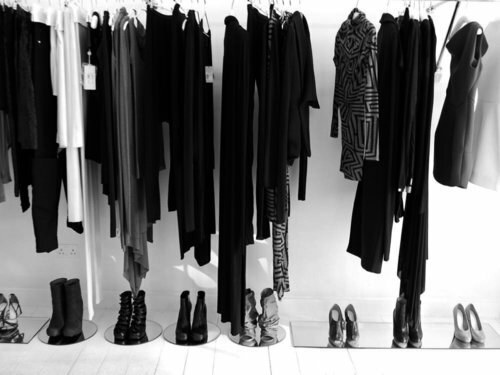
image via www.
Black is the new black and it will always be the new black. This statement stands true for multiple reasons:
- Black is the most flattering of all colors. It is slimming and luxurious and gives off an overall polished look.
- Black pieces can be paired with anything. For example, a black top can be styled with any color bottom. Vice versa, a black bottom – jeans, for instance — can be paired with any color top.
- Black is sexy. The color looks good on everyone and can be dressed up or down yet still hold a quietly seductive look.
- Black is always in style. It can be worn with any trend at any time of year.
- Black is simple and sophisticated. “I think wearing black makes people look more sophisticated and definitely lets your accessories stand out more,” says Lillie Ashenfelter, a junior at SMU.

image via www.cupcakesandcashmere.com
Hailey Curtiss, an SMU senior, says she challenges herself to wear vibrant colors that stand — but always find herself gravitating back to black. Curtiss says this winter her outfits consisted of Blank NYC vegan black leather pants, an oversized black sweater, and black motorcycle boots.
“Most days as I would head out the door my mother would make some disapproving comment like, ‘Hailey you look like you’re going to a funeral,’” says Curtiss. “I would just put on my Prada sunglasses, black naturally, and walk right on past her.”
It’s safe to say that black is a color that will be seen on runways every season. Black is a color that’s here to stay.
A fashion dream-come-true
by Brooke Moore
A Picasso of fashion, Marc Jacobs watched from backstage as the models in his 2013 summer New York Fashion Week show displayed his creations with elegance, sass and certainty.
“Somewhere over the rainbow—again!” Jacobs shouted triumphantly. The show, once again lauded as the “holy grail” of the industry, launched another successful year for Jacobs.
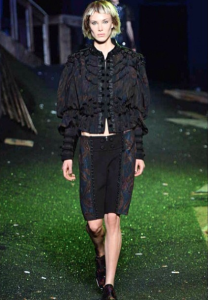
Kelly Gillespie in the Marc Jacobs show during Fashion Week.
The 2013 show was a triumphant moment for another member of Jacobs’ team: For IMG model Kelly Gillespie, it represented her first big break.
A beautiful, photogenic girl with a slender waist and extraordinarily long legs, Kelly Gillespie realized early in her modeling career that it takes more than a pretty face to make it big. And the Jacobs show confirmed she was headed in the right direction.
Getting started
Fifteen-year-old Kelly Gillespie had a bigger agenda than most adolescents. She was an aspiring model from Kansas City, Kansas, with big dreams and talent.
“Kelly had always been a tall and skinny child, but it was more her self-motivation and attitude that made [my family and me] support her early on,” Diane Gillespie, Kelly’s mother, said in an e-mail interview.
“After hitting 5-foot-10 by the end of her freshman year, Kelly and I decided, with a ‘why not’ curiosity, to send off pictures of her to Kim Dawson Agency in Dallas, Texas. Then the agency got back to us, and Kelly was strongly encouraged to try out for the Kim Dawson Model Search that September.”
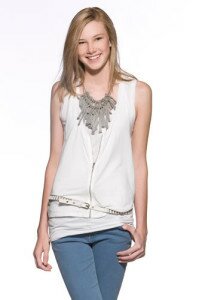
Photograph taken of Gillespie right after the 2009 Kim Dawson model search.
The annual Kim Dawson Model Search has caught the attention of many aspiring models from all over the country for the past 17 years. This being said, Diane and husband Scott Gillespie saw the search as a great opportunity for their driven daughter.
Three of their five children were students at SMU at the time. So when Scott found a job with a Dallas firm, the Gillespie family decided it was time for Kelly to pursue her dream. The family packed up their things and moved to Dallas in the summer of 2009.
In an e-mail interview, Lisa Dawson, manager of the Kim Dawson Agency and daughter of the late Kim Dawson, remembered the youthful Kelly.
“She was still very young at just 15 years old, but we could see the potential there,” Dawson says.

Photograph of Gillespie taken early on in her career.
Kelly was among the nine finalists in the 2009 search, and she signed a contract with Kim Dawson Agency that September. A few months later, she moved to New York and signed with an agency – but didn’t last long.
“I went to castings for Fashion Week runway shows, but clients didn’t book me because I was so young and inexperienced,” she says. “I was 16 and didn’t really know what I was doing. So, I decided to go back to Dallas, gain some more experience there, and then graduate high school before returning to New York to try again.”
Moving Along
Only two weeks after her high school graduation, Kelly said goodbye to her family and friends and returned to New York – but with more knowledge of the industry and “inside” tips for getting past casting agents.
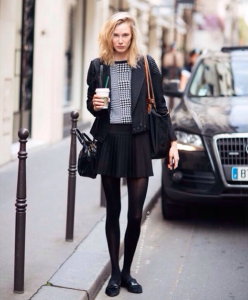
Photograph of Gillespie while walking to a casting in New York City.
“When you go to castings, you try to look as raw as possible, which means no make-up and your hair is completely natural. I would get out of the shower and let my hair air-dry while I’d walk to castings,” Kelly says.
“Casting directors like to imagine a model as a blank canvas they can work from. This way they can envision their masterpiece, making the model into whatever character they wish her to be. ”
This time around, Kelly landed more jobs in New York, and she enjoyed her blossoming career, but she knew she still had a few things to learn.
“Ever since I started modeling at 15, so many agents told me that there comes a time in every model’s career when things start to change and a light bulb turns on,” she says. “When she realizes how being herself and showing off her personality in castings will go a long way.”
She heard the advice she was given; she just didn’t really understand it. “It wasn’t until two or three months after I moved to New York, when I was walking home from a job, and I called my mom and said, ‘I think the light bulb just turned on. I understand now that I need to let loose and show my personality.’”
Making it Big
From then on, she says, she felt more confident when meeting with agencies – and even noticed an improvement in her work. The result? For Fashion Week 2013, Kelly was called in for castings with many top designers. She ended up signing an exclusive contract with Marc Jacobs.
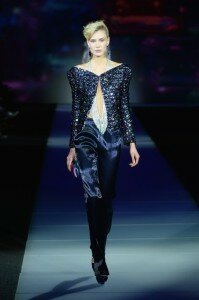
Gillespie hitting the runway for Giorgio Armani’s “One Night Only” in New York.
After Fashion Week, Kelly appeared in shows in London, Milan and Paris during each country’s Fashion Week. “By the time I returned from Europe, I was exhausted. But I was also joyous. I had finally achieved everything I was working toward.”
Before long she was back in Dallas. “I modeled for the Neiman Marcus website, and I was booked for Neiman Marcus last call email ads. In New York, it’s extremely difficult to get print jobs because it’s so competitive. It’s so nice when I come back to Dallas because I have the opportunity to work with big names like Neiman Marcus more often.”

Photograph taken during “Rock N Roll” shoot for FD Luxe’s September Fashion Story.
While in Dallas, Kelly was also booked for photo shoots with FD Luxe and D magazine’s February 2014 issue.
Lisa Dawson notes that Kelly still has professional as well as personal ties in Dallas. “Kelly works steadily for most of the big clients in Dallas,” she says. “She is a dream to work with. Although she comes across as really laid-back, there is no one more professional than Kelly. We get great feedback on her from the clients: She is always well prepared, on time, up for anything and has a great attitude.”
Kelly now works for IMG Models Worldwide and after her stint in Dallas, left for Australia, where she’ll stay for Fashion Week in April.
“If there’s one thing I’ve learned since I started modeling, it’s that experience only works in your favor and can only improve your career,” Kelly says. “You can never have too much of it.”

designing from the dorm
By Courtney Schellin
A small-framed Chinese girl casually walks down the SMU boulevard. Dressed to impress in her skinny jeans, ballet flats and patterned sweater, she is texting on her iPhone 5. But when she looks up her bright eyes and big smile reveal an enthusiastic, yet easy-going nature.
She may look like one of the slew of SMU freshmen — the thing is, she’s different from your average college girl. Much different. She has accomplished something that many middle-aged women can only dream of: her own fashion line.

Mimi Shou’s creative and free-spirited personality offers insight into the nature of her elegant yet simple designs. Photo courtesy of Schellin.
Meet Mimi Shou.
Shou discovered her interest in fashion at a young age, purchasing her first sewing machine in the seventh grade. From there, she began designing clothing and jewelry for fun, even messing with pieces of clothing in her closet, including a dress she once wore as a flower girl, which she would then transform into something completely new and different.
“Ninety percent of the time when I start a project I imagine it as something else,” says Shou. “I just kind of go with the flow and it works out well.”
Longtime friend Hannah Pearson says people began to notice Shou’s talent when she began making jewelry around their sophomore year of high school in Houston.
“After seeing all her jewelry all my friends and I noticed how talented she was and how much she enjoyed making it,” says Pearson.
Designing High School Girl
It wasn’t long before Shou realized she wanted to get her designs noticed.
After hearing about a Houston event called which showcases talented high school students work while also raising money to benefit the American Heart Association, Shou decided to get involved. She reached out to the student making it all happen, Jackie Luo.
Luo, now studying at Columbia, is director of the campus women’s wear fashion magazine as well as editor-in-chief of an online fashion magazine. She says she instantly knew Shou would be a great addition to their team.
“Mimi, who’s always diving into new experiences, was really eager to get involved,” says Luo. “She has a great personality, and she’s really passionate about what she does, which was a refreshing change of pace for me.”
Although she had no previous training in fashion design, Shou dove right in. She went out and bought a dress form and some fabric to work with, even watching YouTube videos to teach her how to design. Soon she was effortlessly designing pieces for the show.

Shou poses with the models wearing her designs at the Fashion Cares show. Photo courtesy of Fashion Cares.
“I just kind of winged it and it turned out OK,” says Shou.
By the day the Fashion Cares show arrived, Shou acted not only as a designer for the event but also as a co-producer.
The next year, she moved on to act as sponsorship coordinator of the event. At the end of the show, Shou felt good about her work — but there was one surprise.
“I even sold two of my designs at the fashion show, so I was like oh, cool, maybe I can actually do this,” she says.
Fellow Fashion Cares volunteers were not surprised that Shou’s designs were so successful.
“She’s so talented,” said Luo. “Mimi’s fantastic with artistic endeavors. I saw her first designs and have worked with her since to shoot editorials.”
Mary Elizabeth Heard got on board with Fashion Cares when Shou reached out to her about designing. She agrees with Luo that when it comes down to it, plain and simple, Shou is smart and clearly has an eye for fashion.

Photo courtesy of “Meems.”
“Mimi’s work is always a crowd favorite as well as my personal. She does a wonderful job of blending simplicity with elegance,” says Heard. “She knows how to design flattering pieces for the female figure while remaining creative.”
After high school, Shou began thinking ahead to a possible career in fashion. When applying for college, she looked into fashion-focused schools such as the Fashion Institute of Design and Merchandising and Parsons.
However, both she and her parents were wary of choosing a school that was too narrowly focused on fashion. When it finally came down to making a decision, Shou chose to attend a more traditional college: SMU.
“I kind of wanted the whole college experience, like join a sorority and have fun. You only get to do that once in your life, so then I came here,” she says.
In the meantime, Shou says, her father is supportive of her fashion hobby and is paying to let her attend a fashion school abroad program this summer so that she can continue to design.
Balancing College and Fashion
For most college freshmen, finding the perfect balance between school and social life doesn’t come easily. And when you throw in a “hobby” as time-consuming as fashion design, life could get complicated. But not for Shou.
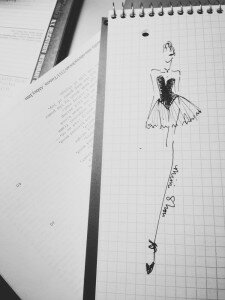
Shou’s design sketches. Photo courtesy of “Meems.”
Rather than becoming overwhelmed by the experience, Shou embraces it, balancing schoolwork, a social life and what she loves — designing.
“Mimi is a very focused person and designer and always works extremely hard on anything she decides to do,” says Pearson. “This past Christmas break Mimi worked almost every day on her designs and put in lots of effort. I helped by trying all her clothes on to make sure they fit correctly.”
Sorority sister Katherine Carroll says it’s interesting to see Shou, who is always working hard in every aspect of her life, achieve such a balanced lifestyle.
“It’s really clear to see when you talk to Mimi the way that she’s set up her life to be so balanced and the way that she carries herself with such grace,” says Carroll. “I feel like she draws inspiration from everything in life and that’s what makes it so cool to see her developing this fashion brand and this whole new path for herself because it’s something that everyone can relate to at our age and in college.”
Part of the way Shou has stayed on track with designing while in college is through her jewelry line called “Meems,” inspired by a nickname she was given in high school.

Meems allows Shou to continue her designing hobby while in college. Photo courtesy of “Meems.”
With over 300 hundred likes on the Meems Facebook profile page and multiple followers on Tumblr and Instagram, her line has profited from online exposure. She says her designs and brand have expanded further than she could have hoped, with people all across the state talking.
“As soon as you hear anything about a student making their own fashion line in their dorm room, I mean, anyone would want to hear more about that,” says Carroll.
Rather than spending the money she is earning from her designs immediately, Shou is saving the earnings to help her father pay for her summer abroad fashion program.
Until then, she’s keeping herself plenty occupied with different projects, including designing for an upcoming benefit fashion show in Houston.
Shou constantly fills her plate with more opportunities to design. Heard says that’s what makes her so great at what she does and will ultimately be what separates her designs from the rest.
“Her style is unique, but not outrageous,” says Heard. “It’s what every girl wants to be wearing.”
smu fashion media becomes major
by Grace Merck
It was late August last year and SMU senior Ashley Gross had a tough decision to make. The deadline to add or drop classes was the following day and she had just hours to decide whether or not to take on a new major and 20 more hours of class.
“Knowing how much I wanted to work in the fashion industry, it was an easy choice. I signed the papers and quickly switched my random elective hours to classes that would fulfill my new major. I know having fashion media as my major will stand out to future employers,” Gross says.
SMU created the fashion media minor in 2011 and it was an instant hit. The immediate popularity of the minor had the administration thinking about the next step. While the minor offers a basic understanding of how fashion media fits into the industry as a whole, it is just a taste of the many ways to explore the different facets of the fashion industry.

learn more about Meadows School of the Arts at www.smu.edu/meadows
In fall of 2012, the SMU Meadows School proposed an interdisciplinary and academically rigorous program that would examine the fashion industry from many different perspectives. The proposal was approved the following spring and by fall 2013 students were able to declare fashion media as a major.
At its core, the fashion media major is a communications program. Students learn the skills they will need in media- related fields such as journalism, public relations and advertising.

students taking the fashion journalism course provide the stories for SMU’s very own online fashion magazine, smufashionmedia.com
Jayne Suhler, a professor in the journalism division, explains that the new fashion media major is “training students to be those fashion critics, bloggers, magazine writers, public relations, marketing, and advertising professionals in a trillion dollar international business.”
Majors also take a concentrated core of fashion courses, designed to provide the specialized knowledge they will need to work in the industry. Other course work, in art history, women’s and gender studies, and sociology, for instance, is designed to provide a broader understanding of the fashion industry and various social, cultural, and economic forces that influence it.
“This is not a basket weaving major in any way, shape or form,” Suhler adds.
The challenging classes that fashion media majors are taking are helping them explore new avenues such as digital media, television and broadcast, and business principles while also solidifying their journalism backgrounds. Gross says, “Taking Reporting II is challenging me to write hard news stories and helps me better understand the fundamentals of great journalism writing.”
The major also has a strong business component to the curriculum. Professor Suhler says that Mark Vamos, the chair of the business journalism program, is “developing fashion business classes for this major that are comparable to Cox business classes.”
Students seem to be up to the challenge. Gross explains, “I’m taking Business of Fashion right now, which has me financially analyzing the fashion industry, something I hadn’t learned yet. It is hard but exciting.”
Professor Chelsea Bell sees the new fashion media major as a pathway to many exciting and diverse career options in students’ futures. “This is a unique program that is emerging during a time when unwritten career possibilities are endless,” she says. “Our students will leave here with a range of skills that will give them the opportunity to write their own paths in the rapidly evolving fashion industry.”
the revival of knox henderson
By Naomi Bowen

When Lauren Langager told her clients she was moving her new salon, L.A.R.C. Salon, to Knox and McKinney, they thought she was crazy. That’s where you go for warehouse furniture not a blowout, many of them told her. But a lot has changed since L.A.R.C. opened in 2012. “The salon very rarely has walk-in clients, since most of our stylists are booked weeks and months in advance,” she said.
The West Knox area, previously frequented primarily by interior decorators, has diversified greatly over the past two years to include major retailers like Lululemon, Kate Spade, and Jonathan Adler, and will continue to grow with a Trader Joe’s and new luxury apartment complexes.
Brian Bolke founded Forty Five Ten, one of the first fashion boutiques to move onto Knox and McKinney in early 2000. Bolke said they moved to the location because it was what he and co-founder Shelly Musselman were able to afford. “Abacus opened when we did across the street, but the area was basically a few restaurants, and no retail except an Army/Navy store,” he said. Bolke and Musselman opened the T Room, the restaurant connected to their 8,000 square-foot boutique, to help bring traffic to the empty neighborhood.
Over the past 14 years, Forty Five Ten has become nationally recognized, featured in such publications as Vogue, Marie Claire, Lucky, and Harpers Bazaar. Bolke said the location dictated that he needed to make the store a destination. Even with the area’s growing popularity, people rarely wander in.
Langager said she chose the Knox and Mckinney neighborhood because it is unique, fun and safe. “The Knox/McKinney area was the ideal spot for both our stylists and clients. It offers everyone easy access and a chic/local environment,” she said. The location has also allowed Langager and her co-owners to add more stylists and chairs to keep up with the growing demand.
According to Jay Neikirk, an associate at TIG Real Estate, the area has shifted to include a lot of mid-level fashion boutiques and retailers. Neikirk credits the change to Dallas’s growing population and cheaper retail rental rates on Knox compared with other trendy areas like West Village. While West Knox is hot right now, he expects the next area of growth across U.S. 75 on Henderson.
Lacey Brutschy, an agent at Carolyn Shamis Realtors, agrees with Neikirk’s projections. “In a few years it will look like McKinney Avenue and Lower Greenville got together to have a another baby in a plaid button-up,” she says, laughing.
By September 2015, L.A.R.C., Forty Five Ten, and their neighbors will be getting two major additions. According to The Dallas Morning News, Sarofim Realty Partners and Lincoln Property Company are building a $38.6 million complex anchored by Trader Joe’s with 165 luxury rentals on top. Brutschy said, “In three years, you’ll be beating yourself in the head for not buying a property that actually grew in value during one of the biggest real estate surges in the 2000s.”
Sarah Blaskovich, the editor of Pegasus News and digital entertainment editor at The Dallas Morning News, credits the West Knox area’s rise in popularity to its proximity. The Katy Trail connects Highland Park, Knox and Uptown — and allows shop owners and Dallas residents ease of access from one neighborhood to the next. Langager said one of her favorite parts of owning a business on Knox is biking to work on the Katy Trail.
Not all the owners in the area are as happy about the Knox expansion, however. Bolke worries the area’s small, one-way streets are not built to handle the added traffic that luxury apartments and a Trader Joe’s will bring to the area. He mentioned the congestion and parking problems that have occurred when popular chains like Chipotle move into the area. “Density is not always better. I wish the focus was on landscaping, trees, fixing potholes, and upgrading the neighborhood to create a place to really walk,” he said.
 Nest — a local gift, art, and furniture store, across from L.A.R.C. on McKinney — exemplifies the area’s new mix. Donald Fowler the buyer and manger of Nest says that the store has grown immensely since moving from Snider Plaza to Knox and McKinney.
Fowler described the Nest and Knox clientele as having a strong appreciation for design and creativity. Langager agrees that the location inspires a creative aesthetic. “Knox/Henderson oozes with creativity among business owners,” she said.
Blaskovich said she’s most excited about the Trader Joe’s, but also loves the neighborhood’s plethora of restaurants. Highland Park Pharmacy, an ol-fashioned soda shop that is one of the oldest restaurants in Dallas, sits at the corner of Knox and Travis. According to the restaurant’s website, when the soda fountain opened in 1912, Knox Street was just a dirt road.
 Down the street is another Knox landmark, Wild about Harry’s. The hot dog and frozen custard shop, marked with brightly painted windows and a smiling hot dog, has been in the area since 1996. Some locals worry that the new luxury apartments may push rents up, possibly forcing some Knox-area mainstays out.
Blaskovich said her favorite mainstays after a walk on the Katy Trail are Chuy’s, dessert and coffee at La Duni, and champagne sangria at Sangria Tapas Y Bar. Bolke said Mr. Mesero is one of his favorite new eateries in the area. Langager agreed with Blaskovich about the area’s great diversity and walkability: “I can start my day at the coffee shop across the street, go shopping at all the cool shops nearby during a break, and have dinner at a nice restaurant after work.”
 Knox restaurant staples include Chuy’s, Wild about Harry’s, and Highland Park Pharmacy.
All images taken by Naomi Bowen
the new club in dallas
By Jenna Veldhuis
We all know a guy who hates shopping, for whom the slightest mention of a visit to NorthPark Center elicits a response similar to that of a trip to the dentist.
However, despite this aversion, the idea of looking good is more popular than ever, thanks to hit songs like Justin Timberlake’s “Suit & Tie” and Jay-Z’s “Tom Ford.” More and more men today want to dress with a certain swagger, but looking good may be hard to come by if they hate to shop.
Take my boyfriend, for example. He’s never been a fan of shopping — partly because of the crowds, the question of what to buy, and his belief that the salesperson is often trying to sell him something he doesn’t need or even want.
Luckily for him, and plenty of other men just like him, the traditional shopping experience may be a thing of the past. Gentlemen – and girlfriends/wives/mothers of these shopaphobic men — may I introduce you to Trunk Club, your one stop shop for all your menswear needs.
The No-Shop Solution To Looking Good

photo by Taylor Lewis
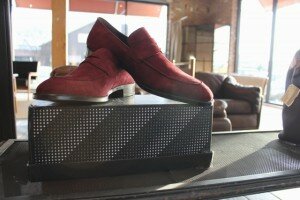
photo by Taylor Lewis

photo by Taylor Lewis
With a showroom recently opened in the Knox-Henderson area of Dallas, Trunk Club also has a location in Chicago as well as an online “store.” They carry many of the same menswear brands you expect to find at upscale department stores like Neiman Marcus as well as “exclusive” items from collaborations with brands such as Jeremy Argyle and J. Press.
“Trunk Club was started to solve a simple problem – shopping for clothes in stores or online just doesn’t work for most guys.” the company website states. “It’s overwhelming, inconvenient, and takes way too much time. With Trunk Club, guys discover awesome clothes that are perfect for them without ever having to go shopping.”
The CEO of the company, Brian Spaly, says in an interview with the Trunk Club blog. “We don’t do fashion shows. We’re not a fashion company. We’re an apparel business and a service business.”
Personal Styling, Service
Since 2011, the company has succeeded with its concept of providing a men’s personal styling service with no membership fees. With a few clicks, any guy can sign up. He’s then matched with a stylist who is charged with learning enough about the client to put together a “trunk” with six to eight items that reflect his style preferences and needs.
Once a man receives his trunk, he can try the clothes on in the comfort of his own home — and is charged only for the items he keeps. The rest are sent back, with complimentary free shipping both ways.
If online shopping isn’t quite a guy’s style, and he happens to live in either the Dallas or Chicago area, an in-house fitting can be arranged. This means a guy can make an appointment with a stylist at the Trunk Club showroom to try on pieces selected to meet his specific needs and tastes.
The Dallas Trunk Club location is the company’s second brick-and-mortar store. Trunk Club stylist Chandler Richards says it was a perfect next move for the Chicago-based brand. “Dallas is a similar city to Chicago,” she says. “It’s not yet a huge fashion hub. Plus the people are stylish and friendly – the perfect fit for Trunk Club.”
Next up: Trunk Club D.C. is set to open later this spring. And, Richards says, the company hopes to expand to other major U.S. cities in the near future.
The Fashion Education of Young Men
Last summer, after Jay-Z’s “Tom Ford” became a hit, my boyfriend asked me if Tom Ford was a “big deal.” Regardless of how comical I found the remark, it did make me realize how big a part popular media are playing in transforming men’s knowledge of fashion.
Ironically, it was my boyfriend who introduced me to the Trunk Club. After hearing from a few friends who had visited the spot — that you could go somewhere where a stylist would pick out clothes you would like and you could sit back with a beer — the concept seemed too good to be true.
Before I knew it, I was joining my boyfriend for his Saturday afternoon appointment with his stylist. Upon arrival, we were offered a drink, then led to an area featuring plush leather couches and pop-up dressing rooms. The stylist explained the concept behind Trunk Club and then asked him a little about his personal style. A few minutes later she returned with a cart full of button-downs, jeans, colorful patterned socks, and a pair of oxfords even Justin Timberlake would envy.
An hour later double — double the time my boyfriend would ever spend shopping – the Trunk Club experience was wrapping up. The best part, he said, was how the experience avoided the awkwardness, even stigma, many men feel when out shopping. Instead Trunk Club felt like a cool place to go for a drink and hang out — while looking at clothes.
“They don’t really know what to expect, but once they really see how awesome it is, they are hooked,” says Richards of most guys’ first reaction to Trunk Club. In her opinion, the concept has become so successful because it isn’t shopping in the traditional sense, it’s about the experience and relationships.
“When the Dallas or Chicago guys come into the showroom for an in-house fitting, they can come in, have a drink and feel comfortable coming to their stylist,” says Richards, adding that for clients, their personal stylist often becomes like a good friend. As for the guys who choose to order the trunk online, she says: “It’s all about the convenience — they love that fact, that they can trust their stylist to [help them] look amazing, with zero effort on their part, particularly no malls.”
Yosi Samra Comes To Town
By Hailey Curtiss
Most women understand the stamina required to wear a pair of high heels throughout day and into the night. It can turn into a test of endurance: Just how long you can you last before giving in and taking off those sinfully painful stilettos?
Designer Yosi Samra, who frequently observed this phenomenon while living in New York City, decided to come to the rescue of women everywhere by creating a fold-up flat a woman could easily carry in her purse — and then slip on when her feet needed relief.

The famous flats
In 2009, nearly overnight, Samra became the “father of the fold-up flat.” His foldable flats have been a hit with some of Hollywood’s hottest “It” girls. Celebrities such as Jessica Alba and Mila Kunis have been photographed wearing Samra’s shoes.
Samra’s fold-up flats are in demand. And now trendy Dallas girls won’t have to travel to NYC to pick up a pair of the fashionable flats. Yosi Samra recently expanded, opening a second headquarters in Dallas.
Samra says that moving into Dallas seemed like a “natural step” for his company. “I visited Dallas several times for market and realized that our business had been increasing much more [here] than in any other region.”
Stanley Korshak hosted his first Dallas event over the holidays. The “Holidays Flats Fete” raised money for The Dallas Children’s Advocacy Center. Each purchase over $200 provided a child with a pair of Yosi Samra flats.
“We were so grateful to have the chance to support a local designer and support The Dallas Children’s Advocacy Center. It was a great turn out of young, fashionable gals at The Shak. It was a wonderful event for a wonderful cause,” says Stanley Korshak’s Leigh Brock.
Samra’s flats have also been a hit with younger fashionistas. Samra says, “Dallas retail business has been booming and our kids market has blown up. The community has embraced our brand, which we are grateful for. Fashion is very important in Dallas. We plan to host events with local charities and boutiques.”

Yosi Samra
This is great news for those who swear by Yosi Samra flats, including SMU student Rebecca Keay. “My favorite thing about Yosi Samra shoes is how comfortable they are, and how easy they are to pack since you can fold them up,” she says.
These foldable flats don’t look or feel like the flimsy, inexpensive flats sold at convenience stores. Each pair of Yosi Samra flats has a “real” sole, making them as sturdy as any other shoe. They also come in a variety of colors and styles ranging from metallic to tweed – perfect for the SMU student who is looking for something functional yet fashionable.
So the next time you’re planning an evening on the town, you don’t need to tough it out. Just slip a pair of Yosi Samra fold-ups in your purse. Your feet will thank you.